

Business Studies (GCSE, Level 2 and 3 BTEC)

Subject vision
Business Vision
At our school, Business education inspires students to become confident, enterprising and ambitious young people who are ready to thrive in an ever-changing world. Through the study of Business at Key Stage 4 and Key Stage 5, students develop the knowledge, skills and mindset needed to succeed in further education, employment and entrepreneurship.
Adventurous Learners
Our curriculum encourages students to explore the exciting and diverse world of business. Through the study of marketing, finance, enterprise, recruitment, business ownership, innovation and strategy, students gain a broad understanding of how organisations operate and succeed.
Whether studying the AQA GCSE Business course, the BTEC Tech Award in Enterprise, or the BTEC National Level 3 Business qualification, students investigate real businesses, analyse contemporary issues and discover the opportunities available within local, national and global economies. We foster curiosity and encourage students to think creatively about the future of business.
Building Resilience
Business learning develops perseverance, adaptability and problem-solving skills. Students are challenged to work through authentic business scenarios, complete coursework and assignments, prepare presentations, conduct research and evaluate business decisions.
Through constructive feedback and high expectations, students learn to respond positively to challenges, refine their work and continually improve their performance skills that are invaluable in education, employment and life.
Developing Independence
We empower students to take ownership of their learning by engaging with real-world business issues and conducting independent research. Students are encouraged to investigate businesses and industries that interest them, developing critical thinking and decision-making skills.
Alongside business knowledge, students gain an understanding of personal finance, employability and professional behaviours, preparing them for the responsibilities and opportunities of adult life.
Motivating Future Success
Business education helps students recognise the wide range of pathways available to them. By linking classroom learning to careers in management, marketing, finance, entrepreneurship, human resources and many other sectors, we help students understand how their studies connect to future aspirations.
Encounters with employers, entrepreneurs and local businesses provide valuable insight into the workplace and inspire students to aim high, regardless of their chosen career path.
Embracing Challenge
We believe every student can achieve excellence. Students are encouraged to think analytically, justify decisions, evaluate evidence and apply their knowledge to unfamiliar situations.
By exposing students to high-quality examples, challenging tasks and ambitious targets, we develop confidence, aspiration and a commitment to achieving their personal best.
Connected to Our Community
Business is rooted in the world around us. We actively connect learning to our local community by exploring the work of local enterprises, entrepreneurs and employers. Students develop teamwork, communication, leadership and interview skills through collaborative projects and practical activities.
These experiences help students become work-ready, socially responsible and equipped to make a positive contribution to their communities, both locally and beyond.
Our Aim
We aim to develop enterprising, resilient and ambitious young people who leave school with the confidence to create opportunities, solve problems, lead others and make informed decisions. Through Business education, students gain not only qualifications, but also the skills, knowledge and character needed to succeed in a rapidly evolving world.
Homework
Homework is set weekly and is related to the topics studied in class, at that time. These include a variety of activities, from set questions to research, and coursework based tasks.
Our Learning Journey
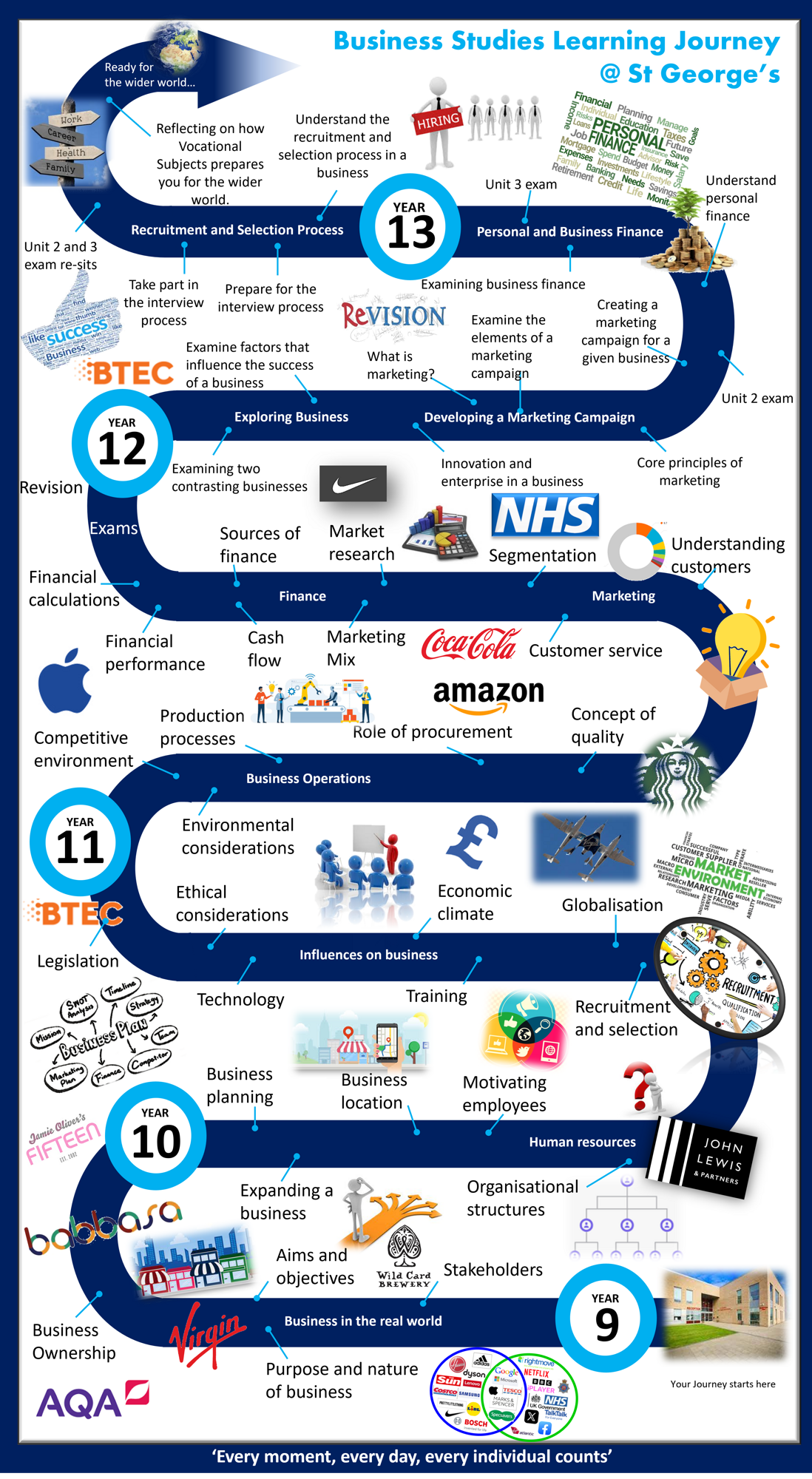
Revision - BTEC Level 2 Tech Award (Year 11) / GCSE (Year 10)
Revision - BTEC Level 2 Tech Award (KS4)
GENERAL INFORMATION (USEFUL INFORMATION FOR PARENTS)
Students studying level 2 Enterprise will receive four timetabled lessons a week, in Year 11.
Component 1 and 2 were studied and assessed in Year 10.
These are by way of PSA (Pearson Set Assignments) that are undertaken under exam conditions in the classroom.
Component 3 is studied and examined in Year 11.
Teaching and learning for component 3 tend to commence in the latter part of term 4, once the final PSA is concluded. In Year 11 pupils will spend the first term continuing their study of comp 3 and term 2 tends to be predominately for revising for their January exam. Students will have the opportunity to re-sit this exam in the summer of Year 11.
|
Personal Learning Checklist |
The Level 2 Component 3 PLC - BTEC Tech Award PLC can be found here. The Course Specification can be found here. |
|
Example Exam Questions/Model Answers |
Past exam paper and the corresponding mark schemes can be found here. |
|
Revision Materials/SharePoint |
All lesson resources and revision materials can be found in our central SharePoint location: Pupils must log in with their username as their usual computer login followed by @st-georgescofe-thanet.kent.sch.uk [e.g. JSmith123@st-georgescofe-thanet.kent.sch.uk] and the usual password they use to log on to school devices. |
|
Revision Guide |
Pearson REVISE BTEC 2022 Tech Award Enterprise Revision Guide inc. online edition - £4.31 ISBN: 1292436115 Please note: This will be loaned to students in year 11. |
Revision – AQA GCSE Business 8132 (KS4)
GENERAL INFORMATION (USEFUL INFORMATION FOR PARENTS)
Students studying GCSE Business will receive four timetabled lessons a week, in Year 10 and 11.
Subject Content 3.1 to 3.3 is studied in Year 10.
Topics are taught and mini-assessments are carried out at the end of the topic which tend to be questions from past AQA GCSE Business papers.
Students will undertake mock examinations after the Easter Break.
Subject Content 3.4 to 3.6 is studied in Year 11.
Topics are taught and mini-assessments are carried out at the end of the topic which tend to be questions from past AQA GCSE Business papers.
|
Personal Learning Checklist |
The GCSE Business PLC – AQA can be found here. The Course Specification can be found here. |
|
Example Exam Questions/Model Answers |
Past exam paper and the corresponding mark schemes can be found here. |
|
Revision Materials/SharePoint |
All lesson resources and revision materials can be found in our central SharePoint location: Pupils must log in with their username as their usual computer login followed by @st-georgescofe-thanet.kent.sch.uk [e.g. JSmith123@st-georgescofe-thanet.kent.sch.uk] and the usual password they use to log on to school devices. |
|
Revision Guide |
GCSE Business AQA Revision Guide (with Online Edition, Videos & Quizzes) - £6.85 Product code: BUAR44 ISBN: 9781782946892
GCSE Business AQA Complete Revision & Practice (with Online Edition, Videos & Quizzes) - £13.75 Product code: BUAS42 ISBN: 9781789080889 |
Revision - BTEC Level 3 National (KS5)
GENERAL INFORMATION (USEFUL INFORMATION FOR PARENTS)
- Paper examination
- Range of questions from multiple choice to extended written answers
- Graded from U through to Distinction
| Personal Learning Checklist |
Unit 2 = Click Here Unit 3 = Click Here |
|---|---|
| Example Exam Questions/Model Answers |
Unit 2 Unit 3 |
| Revision Materials/Sharepoint | Click here (Pupils must log in with their username as their usual computer login followed by @st-georgescofe-thanet.kent.sch.uk (e.g. JSmith123@st-georgescofe-thanet.kent.sch.uk) and their usual password they use to log on to school laptops) |
Careers and Future Opportunities
Studying Business equips students with the knowledge, confidence and transferable skills needed to succeed in a rapidly changing world. Through the BTEC Tech Award in Enterprise, AQA GCSE Business and BTEC National Level 3 Business, students develop expertise in communication, problem-solving, teamwork, leadership, financial awareness, decision-making and analytical thinking.
These skills are highly valued by employers and provide excellent preparation for university, apprenticeships and a wide range of careers across both the public and private sectors. Business is one of the most versatile subjects available, opening doors to careers in virtually every industry, including technology, sport, healthcare, finance, retail, media, manufacturing, hospitality and the public sector.
Career Pathways
Business students may progress into careers such as:
Marketing and Digital Marketing
- Marketing Executive
- Brand Manager
- Digital Marketing Specialist
- Social Media Manager
- Market Research Analyst
- Public Relations Officer
Finance and Accounting
- Accountant
- Financial Analyst
- Auditor
- Banking Professional
- Payroll Manager
- Investment Analyst
Human Resources
- HR Advisor
- Recruitment Consultant
- Training and Development Officer
- Employee Relations Manager
- Human Resources Business Partner
Management and Leadership
- Business Manager
- Operations Manager
- Project Manager
- Retail Manager
- Supply Chain Manager
- General Manager
Entrepreneurship and Enterprise
- Business Owner
- Entrepreneur
- Start-Up Founder
- Business Consultant
- Franchise Owner
Sales and Customer Relations
- Sales Executive
- Account Manager
- Business Development Manager
- Customer Success Manager
- Commercial Manager
Emerging Careers
As the business world evolves, students may also pursue careers in:
- E-commerce and Online Retail
- Digital Content and Social Media Strategy
- Data and Business Analytics
- Sustainability and Corporate Responsibility
- Project and Change Management
- Customer Experience Management
- Business Technology and Innovation
Further Education and Apprenticeships
Business qualifications provide a strong foundation for progression into higher education and professional training. Many students continue their studies through:
- Business Management degrees
- Marketing degrees
- Accounting and Finance degrees
- Economics degrees
- Human Resource Management degrees
- International Business degrees
- Degree Apprenticeships
- Higher Apprenticeships in Business, Finance, Marketing and Management
The broad nature of Business also supports progression into courses and careers beyond traditional business disciplines, including law, public services, sport management, event management and hospitality management.
Exploring Future Careers
We encourage students and parents to explore current career opportunities, labour market information and progression pathways through the following trusted resources:
Careers Information
- National Careers Service: https://nationalcareers.service.gov.uk
- Careerpilot: https://www.careerpilot.org.uk
- Success at School: https://successatschool.org
Apprenticeships
- Find an Apprenticeship: https://www.gov.uk/apply-apprenticeship
- Amazing Apprenticeships: https://amazingapprenticeships.com
Labour Market Information
- Careerometer: https://www.careerometer.com
- Office for National Statistics (ONS): https://www.ons.gov.uk
Higher Education
UCAS: https://www.ucas.com
Enterprise and Employability
Young Enterprise: https://www.young-enterprise.org.uk
The King's Trust: https://www.kingstrust.org.uk
These resources provide up-to-date information on career pathways, entry requirements, salaries, employment trends and future opportunities, helping students make informed decisions about their next steps.
Skills for Life
Business education is about more than preparing students for a specific career. It develops the ability to think critically, solve problems, communicate effectively, work collaboratively and make informed decisions. Students learn how organisations operate, how markets change and how people work together to achieve success.
These skills are transferable to any profession and help students become confident, adaptable and employable young adults who are prepared for the opportunities and challenges of the modern workplace.
Our Aim
At our school, we aim to inspire the next generation of entrepreneurs, leaders, innovators and professionals who will make a positive contribution to their communities and the wider economy. Through Business education, students gain not only valuable qualifications but also the ambition, resilience and real-world skills needed to thrive in an increasingly competitive and interconnected world.